By Spalls Waste Management Editorial Team · Updated 3 September 2026
Waste removal in London can be more complicated than loading unwanted items into a van. Limited parking, narrow entrances, stairs, lift bookings and restricted loading times can all affect how a collection is planned. The contents also matter because furniture, rubble, electrical equipment and potentially hazardous materials may require different handling and disposal routes.
This guide explains typical rubbish removal prices, the factors that affect a quotation and the main London waste disposal options. It is intended for homeowners, landlords, letting agents, property managers and businesses arranging anything from a small rubbish collection to an urgent commercial waste clearance.
How Much Does Waste Removal in London Cost?

Waste removal London costs vary considerably because every load and property is different. Checkatrade’s UK cost guide currently gives a broad project range of £75 to £595, with an average of approximately £335. It also reports an average of £60 per hour or £75 per cubic yard, although prices tend to be higher in London and the South East. These are national ballpark estimates not Spalls Waste Management prices and customers should obtain a quotation based on their particular job.
A quote will usually consider the volume and weight of the load, the type of material, the labour required and the journey between the property and the vehicle. Dense materials such as soil, rubble and tiles can cost more to handle than lightweight furniture occupying the same amount of space. Bulky waste such as mattresses, appliances and large cabinets may also carry individual handling or disposal charges.
Access is especially important in London. An accessible ground-floor collection with nearby parking is quicker to complete than one involving several flights of stairs, a long carrying distance or a restricted loading bay. A collection in Hackney or another busy borough may also require additional planning around parking, building access and permitted loading times.
For an accurate quotation, provide:
- Photographs showing the complete load
- The collection address and property type
- An itemised description of the materials
- Details of stairs, lifts, gates and access codes
- The approximate carrying distance
- Parking or loading restrictions
- Information about heavy, sharp or hazardous items
- The preferred date and required timeframe
When comparing rubbish removal prices, review what each figure includes. Confirm whether loading, labour, transport and disposal are covered and whether there are extra charges for heavy or specialist items. If a rubbish removal company offers a free quote, ensure it is based on a clear description of the job rather than an unexplained minimum price.
Which London Waste Disposal Option Should You Choose?
The main London waste disposal options are council collection, a household recycling centre, reuse or donation, skip hire and professional waste clearance. The right option depends on the quantity, whether the customer can transport it and whether specialist handling is necessary.
Council services can be suitable for routine household collections and selected bulky waste. Charges, booking systems and accepted items vary between boroughs, so residents should review their council’s current rules. Household recycling centres may be appropriate when residents can transport separated materials themselves, although vehicle restrictions, proof-of-address requirements and acceptance limits may apply.
Furniture, appliances and household items in usable condition may be suitable for donation or reuse. Other materials can be separated for recycling where the correct local facilities are available. Waste electrical and electronic equipment—usually shortened to WEEE should be kept separate from general rubbish so it can enter an appropriate collection or recycling route.
Skip hire works well for projects that generate material over several days, while a professional waste clearance service is often more convenient when everything is ready for immediate collection. Biohazardous or unidentified material should be left for a specialist team rather than placed in a general skip or taken to a public facility.
The waste hierarchy prioritises prevention, reuse and recycling before recovery and final disposal. Landfill sits at the bottom of that hierarchy and should not be treated as the automatic destination for every load. The government’s waste hierarchy guidance explains how businesses and public bodies should consider these options.
Rubbish Clearance London: Services for Different Properties

People searching for rubbish clearance London services may be dealing with anything from unwanted furniture to illegal dumping or contaminated materials. Before recommending a collection method, a provider should understand where the material came from, what it contains and how safely it can be accessed.
Spalls Waste Management’s waste clearance services include:
- Fly-tipping removal
- Hoarder clearances
- Squat clearances
- Communal bin-store bulk removals
- Post-construction collections
- Biohazard waste collection
A house clearance may contain furniture, personal belongings, electrical items and general rubbish, whereas a garage clearance might include heavy tools, timber, paint containers or garden equipment. A garden clearance can involve soil, branches, fencing or treated timber. Customers should provide a complete description because not every material can follow the same disposal route.
Office clearance London projects can also require advance planning. Desks, chairs and shelving may be suitable for reuse or recycling, while computers and other electrical equipment may be classed as WEEE. Confidential papers and data-bearing devices should be identified before an office clearance begins rather than mixed into a general load.
Hoarder clearances require particular sensitivity. The scope should be agreed with the customer, and anything that must be retained should be identified before removal starts. Fly-tipping and squat clearances can present different risks because the contents may be unknown; sealed containers, sharps and suspected contamination should not be handled without an appropriate assessment.
Man and Van Waste Clearance or Skip Hire?
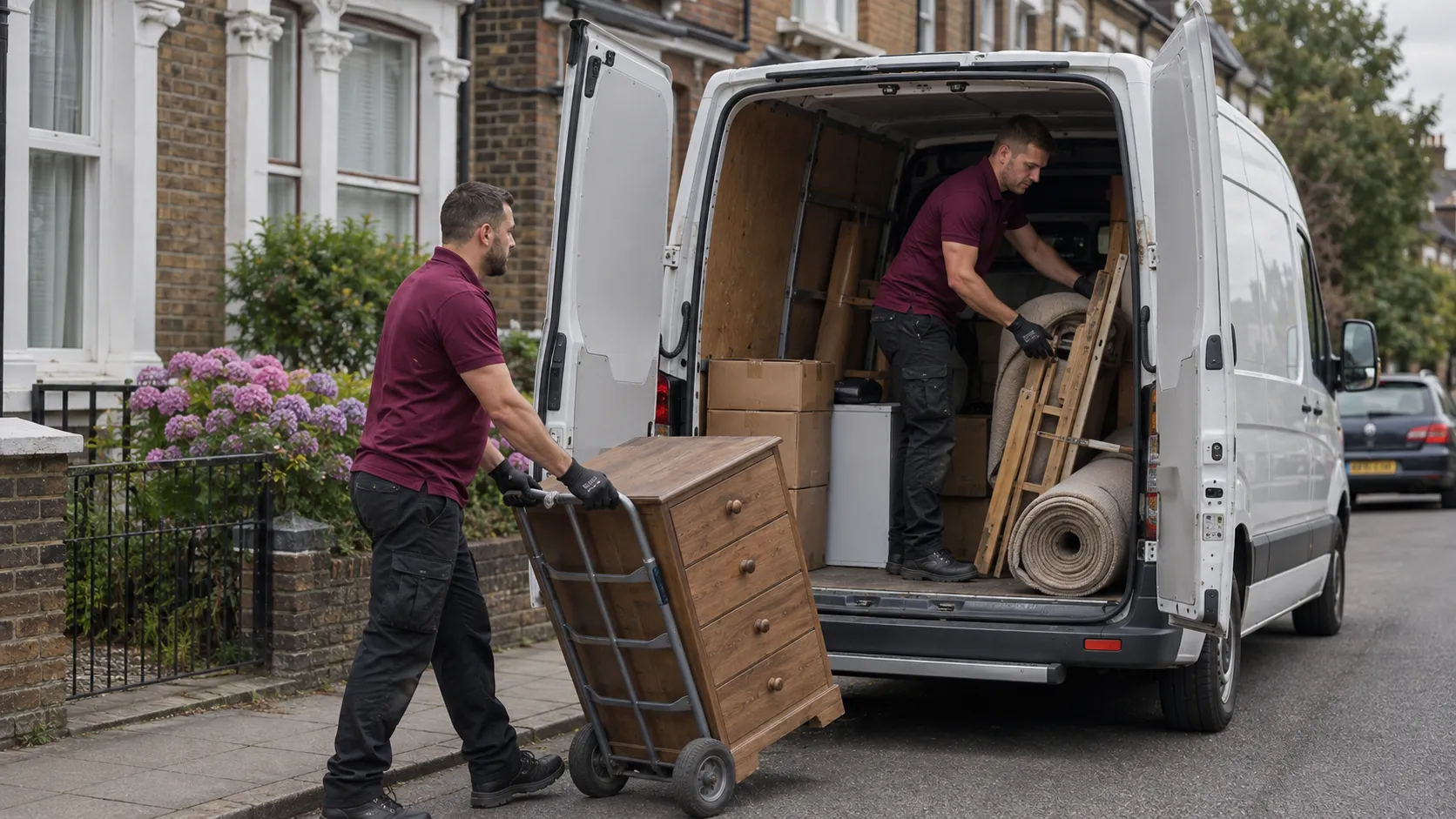
Man and van waste clearance generally includes a team arriving, loading the agreed items and taking them away during the same visit. It can suit a completed house clearance, garage clearance, office clearance or a smaller collection where the customer needs help with lifting.
Skip hire provides a container that remains at the property for an agreed period. This can be useful during building or renovation work because materials are produced gradually. The customer or contractor normally loads the skip, and suitable private space is required unless permission is obtained to place it on a public road.
Checkatrade’s current cost guide lists UK ballpark averages of £175 to £360 for skip hire and £64 to £94 per hour for a man-with-a-van service. These figures are only a starting point: London rubbish removal costs can differ according to skip size, location, labour, material weight and the number of journeys required.
Choose man and van waste clearance when the load is ready, lifting support is needed or there is nowhere suitable to keep a skip. Consider skip hire when a project will create material over several days and someone is available to load it. For a fair comparison, ask both providers to price the same quantity and confirm which materials they will accept.
Emergency Waste Removal London: What to Do First
Emergency waste removal London support may be required following fly-tipping, an overflowing bin store, a squat or the discovery of material that could create a hygiene or safety risk. Keep people away from the affected area and avoid opening containers or handling unidentified chemicals, needles and suspected biohazards.
Spalls Waste Management operates a 24-hour service and advertises a rapid response time of two to four hours across London, Essex and surrounding areas. This is a response window, not a guarantee that every clearance will be completed within four hours. Completion depends on the volume, access, material type and whether specialist arrangements are necessary.
Provide the exact address, an on-site contact, photographs and access instructions when requesting emergency assistance. Landlords and letting agents should also retain an incident record containing the date, location and before-and-after photographs. This creates a useful record for property management and any subsequent service review.
Spalls provides fly-tipping, squat, bin-store and biohazard removal as part of its professional waste management service. Its website states that staff are trained in appropriate handling procedures and that documentation is provided for collections and disposal.
Commercial Waste Removal London: Compliance and Planning
Commercial waste removal London services can cover office clearance, post-construction material, bulk rubbish and communal bin-store collections. Businesses and property managers should plan around the material produced, available storage, collection frequency, building access and opportunities for recycling.
Regular commercial waste collection can help prevent overflowing containers and keep shared areas usable. Before agreeing a schedule, review the expected volume, collection times and separate recycling streams. Commercial waste collection arrangements should also be reconsidered when occupancy, business activity or the type of material changes.
Businesses have a duty to keep their waste secure, describe it accurately and transfer it only to an authorised person. A transfer of non-hazardous commercial waste normally requires a waste transfer note or another document containing the required information. Hazardous material is subject to additional controls and may require a consignment note.
Customers often use the phrase “licensed waste carrier,” but registration is the important legal check in England. A licensed waste carrier should be able to provide its registration details, which can be checked on the Environment Agency public register. Householders should make this check when using private rubbish removal services, while businesses should retain the appropriate records for their collections.
Professional waste clearance provides more than transport. A dependable service should assess the load, plan safe access, identify special handling requirements and provide the documentation relevant to the job. This is especially important for landlords, letting agents and commercial clients managing multiple properties or responding to unexpected bulky waste.
Spalls Waste Management is a family-run company delivering tailored removal services across London and the South East. Its core work includes fly-tipping, hoarder and squat clearances, bin-store bulk removal, post-construction material and biohazard collection. To discuss your site and receive a tailored price, request a quote from Spalls Waste Management.
